


Nail fungus (onychomycosis) on the legs is an illness that has developed from the damage of the nail plates with mushrooms with dermatophytes (up to 96%), less frequently shapes and yeast (approx. 4%).The infection most often spreads from the skin of the feet with long mycosis on the legs.Here it finds favorable conditions for development - increased humidity and nutrients.The structure is disturbed under the influence of pathogens and the color of the nail plates changes.Your complete destruction occurs over time.
Onychomycosis is not only a cosmetic defect, but also a serious disease that is subject to recognition and adequate treatment under the supervision of a dermatologist.
The fungus on the legs is recorded in millions of people in the world.About 5% of the total population suffer from onychomycosis.The most widespread disease is common in humans in 50 to 60 years.Every second person is sick in this age group.The treatment of pathology is difficult for you due to the presence of somatic pathology, mainly vascular and endocrine.Men are sick more often than women.Older people become sick more often than young people.Children rarely suffer, mainly mainly suffer from serious diseases.With AIDS, the disease has an atypical picture.
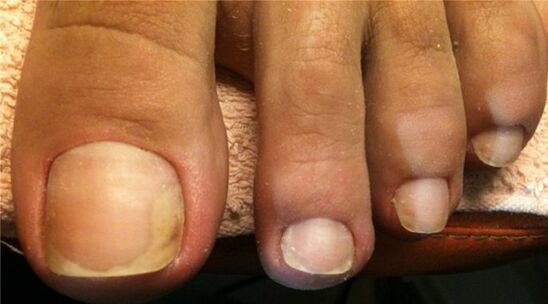
The causal means of onychomycosis
The cause of onychomycosis on the legs is different types of mushrooms: dermatophytes, yeast -like or shaped mushrooms separated or in combinations.
- Dermatophyte mushrooms make up to 90% of all onychomycosis.They are represented by mushrooms of the genus trichophyton (mostly T. rubrum and T.Mentaltagrophytes var. Interdigital).Most of the time, the nail plates on the legs of Trichophyton rubrum are affected.Dermatophytes are common in countries with a temperate climate.
- The yeast -like mushrooms of the genus Candida onhomycosis on the legs rarely cause.They make up about 3% of all onychomycosis.In addition to Candida Albicans, mushrooms such as S. Tropicalis, S. Parapsilosis and S. Guillermondii also cause the disease.
- Most molds are unable to cause nail fungi themselves.Only a few of their species are independent pathogens - these are Scytalidium Hyalinum and S. Dimidiatum (Nattrassia Magniperee) that are not inferior to dermatophytes.Onychomycosis on the legs are such forms such as Scopulariopsis Brevicaulis, Aspergillus Spp., Pyrenochaeta Unguis-Homanis, Alternaria Spp., Fusarium spp.et al.The infection is most common in countries with a hot and damp climate - tropics and subtropics.
Epidemiology of the disease
Most of the onychomycosis is an anthropophilic infection.They are sick and mainly spread infections.
Dermatophyte mushrooms
The reservoir and the source of dermatophyte mushrooms are a sick person whose pathogens are transmitted with direct contact or their personal objects.The infection almost always extends to the nails on the legs with the affected feet, the illness of which is both clearly and secretly (deleted forms of mycosis).The risk of infection increases repeatedly in the presence of an illness in one of the family members.
Mushrooms are transmitted by infected shoes, clothing, files and nipors for nails, carpet, linen, towel, washcloths, etc.The gearbox of the infection occurs when the shared bathroom, in the shower, the sauna, the pool, the gyms and on the beaches.It contributes to the entry of mushrooms in the feet by going barefoot in the public areas.The pathogens live on wooden floors and floors for a long time.
Yeast -like mushrooms
The yeast -like mushrooms of the genus Candida are saprophytic flora and always live on the skin of a person.A good immune system is retained by the growth of pathogens.Extended intake of antibiotics, contraceptives, glucocorticoids and cytostatics, endocrine pathology (often diabetes mellitus) and a number of diseases that exhaust the immune system.The nails penetrate explosive mushrooms from the skin and the patient mucous membranes or enter the human body with infected products that are rich in carbohydrates.
Shape
Forms live in the ground.Your disputes fall on products, things and environmental objects.Nedimatophytes do not spread among people.
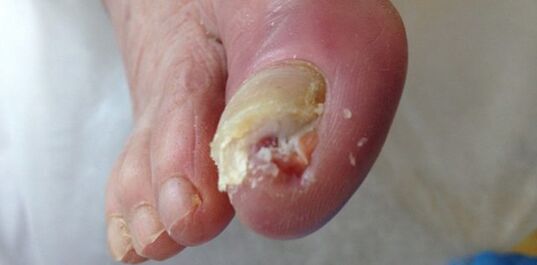
Risk factors for the development of the disease
For mushrooms, diematophytes are characterized by an inherited predisposition, male gender, older age, vascular diseases, diabetes mellitus, immune deficiency states, increased sweating, nail injuries and the presence of another dermatomycosis.
The infection of yeast -like mushrooms of the genus Candida is characterized by increased temperature and humidity, immune deficiency, increased blood sugar, nail injury and non -compliance with personal hygiene rules.
Heavy immune deficiency and nail injuries are characteristic of infection with mold.
Endangered groups
The risk group for the development of onykhomycosis includes ::
- People who are constantly using changing rooms, showering, saunas, etc., etc.
- Professional athletes (swimmers, soccer players, athletes, etc.).
- Military personnel and other groups of people who use proprietary shoes.
- Male faces.
- Age is older than 60 years.
To develop the mushroom on the legs:
- Wear tight, densely adjacent shoes.
- Increased sweating or dry legs.
- Injuries and abrasion of nails, feet, ingrown nails, etc.
- Accommodation in the wet and hot climate.
- Go barefoot in public locations.
- The presence of skin diseases in which nail ceratization (psoriasis, ichthyosis) is disturbed.
- Diseases such as diabetes mellitus, immune deficiency states, circulatory diseases of the lower extremities, blood diseases, extended absorption of corticosteroids, antibiotics and cytostatics.
- Genetic predisposition.
Fleet fungus development path
There are various ways to penetrate mushrooms into the nail plate:
- Distal or distalateral (from free or lateral edge).
- Superficial (directly through the nail plate).
- Proximal (Subtyo -Gut).
Distal-lateral path of mushroom penetration
The distal or distal landing path of penetration is characteristic of Trichophyton-Rubrum mushrooms.The pathogens are inserted into the nail plate by the free edge (distal) or side regions (lateral edge).The main inflammation process occurs in the nail bed, where increased cell proliferation occurs.The stingy layer of skin on the open border thickens (hyperkeratosis), with the nail plate and peeling (onycholysis) lifted and peeled.
Furthermore, the infection spreads towards the hole and penetrates into the nail plate, which is gradually (slowly) destroyed.If the matrix is damaged, total dystrophic onychomycosis occurs.
The hyperkeratosis of the nail bed is observed in chronic eczema, psoriasis, warts, red flat braids.
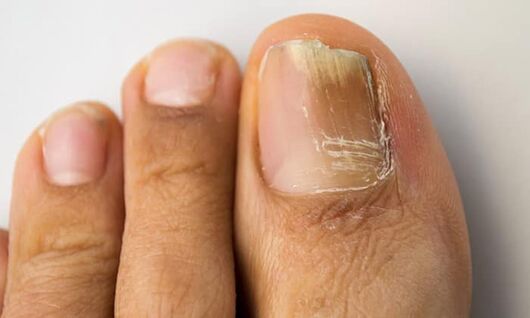
Superficial path of the mushroom distribution path
Mushrooms Trichophyton mentagrophyte var. Interdigital is more aggressive than others in relation to the horny structures of the nail plates.They mainly influence the outer part of the nail plate and cause the development of white surfaces -onychomycosis.Mushrooms under the influence of keratinaz enzymes go through the layer of the layer with hyphen and gradually record all layers of the nail plate.Most of the time, 1 and 5 toes are affected.Those who are exposed to the greatest trauma of shoes while walking.In the disease, 1 and 4 intercal lines are affected.
It is believed that the surface shape of onychomycosis can also be caused by the mushroom-non-humanatophytes: acremonium spp., Fusarium oxyssporum and some types of aspergillus.
Proximal mushroom distribution path
There is a third way to penetrate mushrooms into a nail plate - through a proximal nail roller and a nail bed.The defeat begins with the skin in the area of the nail roller, which from the surface of the nail thick and peel.In addition, the last part of the matrix and the nail bed are involved in the process, with damage to furrows, irregularities and cracks appearing on the nail.With the penetration of pathogens into the nail plate, the nail receives a white impermeable color over time.Over time, a complete destruction and loss of the nail plate is determined.It is more common in HIV-infected patients with the spread of infections from blood vessels.
Features of damage to yeast -like mushrooms of the genus Candida
The damage to the mushrooms of the genus Candida begins with a paroons - inflammation of the proximal role (near the hole).Its edema and thickening are determined, which leads to the separation of the cuticle from the surface of the plate.In addition, the mushrooms fall freely into the matrix and the nail bed, which causes the nail from the tissues of the finger over time.
Features of damage to mushrooms through incorpoons
Nail damage to the mushrooms with non -hostatophytes are secondary.Forms (often scytalidium spp.) In the already affected nail cracks, space between the scallops of the nail bed or bleak vessels.Next, hyperkeratosis and slow destruction of the nail plate develop.
Clinical forms of onychomycosis on the legs
There are different forms of onychomycosis on the legs:
- Distal-lateral.
- White superficial.
- Proximal.
- Totally dystrophic.
Distal-lateral submarine ons on the legs
This form of the disease is the most common.In most cases, the cause of onychomycosis is dermatomycetes, especially Trichophyton rubrum.The pathogens penetrate the nail plate from the side of the free edge and on the side edges.Perenophaeum -Hyperkeratosis arises, which is why there is a replacement of the nail from the finger tissue (onycholysis), it loses transparency, receives a whitish or yellow color, begins to crumble.The nail plate seems to be thickened with the development of a U -boat hypereratosis.With the progress of the disease, the lesion focus expands towards the hole, as shown by the emerging yellow strips.Over time, the entire nail plate and the matrix are involved in the pathological process, which leads to dystrophy and destruction of the nail over time.
In older people, pronounced hyperkeratosis (thickening), onychogrifosis (thickening and deformation in the form of poultry claws) or bulky shilies (concave deformation) is often observed.Your nails are often affected by mixed flora - dermatophytes, shapes and even bacteria.

Surface (white) form of onychomycosis on the legs
The white surfaces -onychomycosis on the legs is the second largest form of distribution of damage.Its cause is mainly trichophyton mentagrophyte var.Mostly from the nail on the first finger of the leg, less often - affected on the fifth.
First, small white spots and strips appear on their surface, which finally captivates an increasing surface.The color is gradually yellow, ocher.The surface of the nail becomes loose, rough, powdery and jumps off slightly.Dickening and separation from the nail bed do not occur.
The proximal U -boat form of onychomycosis on the legs
This form of mycosis is a rarity.It makes up about 3% of all onychomycosis.The reason is the yeast -like fungi of Candida Albicans and Trichophyton Rubrum.The nail candidiasis precedes the inflammation of the periological roller.It swells, acquires red and becomes brilliant.The cuticle is raised and the infection penetrates into the last part of the matrix and the nail bed if it is damaged by the furrow, irregularities and cracks on the nail plate, the loss of the natural brilliance and the cloudiness.The nail is gradually destroyed and disappears in severe cases.This form of onychomycosis on the legs can often be found in HIV-infected patients.
Total dystrophic form of onychomycosis on the legs
This form of onychomycosis develops more often with a long -term current (chronic course), the cause of which is more often the fungi of Trichophyton Rubrum and Candida Albicans.At the same time, the nail plate, the bed and the matrix are involved in the pathological process.The sorry for the nail takes place as a result of the development of the U -boot hyperkeratosis.Over time, the nail plate is destroyed and the new one does not grow due to the affected matrix or does not grow badly.
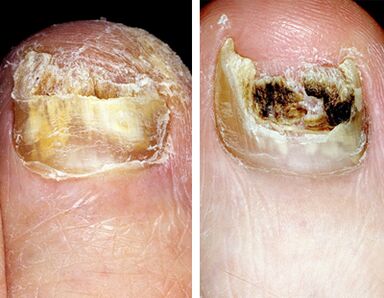
Types of damage to the nail plates
There are 3 options for onychomycosis:
- Normotorophical.
- Hypertrophic.
- Atrophic.
Normotrophic type of onychomycosis on the legs
With a normotrophic type, the infection in the upper layers of the nail plate is located.Its thickness and color in the disease does not change, but stains and stripes are visible in the depths.The color of the nails varies from white to saturated yellow.After a while, the stains and stripes merge.The damage area spreads to the entire nail plate, with the exception of the moon.It is not observed that breaking and checking is observed.Sometimes a slight loosening of the free edge is noted.Healing is possible with appropriate treatment.
Hypertrophic type of onychomycosis on the legs
This type of onychomycosis is the most common.As a result of the development of the U -boot hyperkeratosis, the nail plate is significantly thickened, deformed and loses its shine.Nails become uneven, dull, acquire a brownish gray color and crumbles.The lunar area is not affected.The disease gives the patient concrete symptoms.In older patients, the development of onychogrifosis is determined - the nails thicken, extend and bend like a bird claw.
Atrophic type of onychomycosis on the legs
With an atrophic (onycholithic) type, the nail plate quickly loses its connection from the nail bed, many cavities appear in their layers, fade, becomes thinner and changes the color in whitish or yellow-white.The surface remains smooth for a long time.A partial destruction occurs over time.
Signs and symptoms of nail fungus
Most of the time the nail change begins with a free (distal) or lateral (lateral) edge.
Color change.With onychomycosis, changing the color of the nail plate is the first sign of the disease.It becomes opaque, often loses its shine, receives a white or yellow color, whereby overlapping is brown, brown, green and even black.
Thickening.The increase in the number of horny masses as a result of the development of the U -boat hyperkeratosis leads to thickening of the nail.
Squeeze and destruction.In the event of diseases due to the vital activity of mushrooms, the nail plate crumbles first and completely destroyed over time.

Features of nail damage with different types of onychomycosis
Damage to nails with different types of fungal diseases have its own properties.The main types of pathogens are Trichophyton rubrum (70 - 90%) and Trichophyton -Mentagrophyte v.Interdigital (8 - 30%).Candida albicans, mold, T. Mentagrophyten V. Gypseum, T. Verrucosum, T. Tonsuras and T. Violaceum, epidermophyton floccosum, trichophyton are much less common.Schonleinii.
Onychomycosis on the legs with rubber
Rubrophytics in the Russian Federation accounts for 70 to 90% of all mycons.The feet in the disease are most often affected (usually a squamous epithelial type).An indispensable satellite of Rubrophytia of the feet is a nail fungus on the legs.With mycosis, the distal -dilutal form of onychomycosis usually develops, pronounced hyperkeratosis is characteristic, several fingers on the leg are immediately affected and often fingers of a hand.The disease takes place without special subjective sensations.Pain and symptoms when wearing shoes occur with pronounced hyperkeratosis, onichogrifosis and an ingrown nail.The source of infection is often in the patient's family.
Associated onychomycoses are often recorded: Trichophyton Rubrum and Candida Albicans, Trichophyton rubrum and shapes.It is important to evaluate the cultural study.
Onychomycosis on the legs with t.Mental mushrooms.V.Interdigital
Mushrooms T. Mentagrophyten.V.Interdigitale influence the skin of the feet and nails.Epidermophytosis makes up 10 to 30% of all feet.
In the case of the disease, the upper (dorsal) part of the nail plate is affected.The superficial white shape of onychomycosis usually develops.The pathological process is mainly on 1 and 5 toes (they are subject to the greatest trauma by shoes while walking) and 1 and 4 inter -pack folds.Infections are transmitted when using a common bath, in the shower, the sauna, the pool, on the beaches and the pool.
Onychomycosis on the legs with damage to the yeast -like mushrooms of the genus Candida
This form of mycosis on the legs is a rarity.It is less than 3% of all onychomycosis.The disease is often recorded in people with chronically generalized candidiasis.The damage to the nails usually begins with inflammation of the periological roller near the hole.Its edema and thickening are determined, which leads to the separation of the cuticle from the surface of the plate.In addition, the mushrooms fall freely into the matrix and the nail bed (proximal subnible shape) when grooves, irregularities and cracks appear on the nail, a loss of natural brilliance and the turbidity appear, a brownish brown color shows.The nail is gradually destroyed and disappears in severe cases.
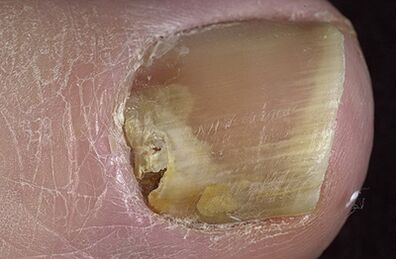
Onychomycosis on the legs caused by shapes
Plastic mushrooms are filled into an already affected nail - cracks, into the rooms between the scallops of the nail bed or the bleak vessels.Next, a hyperkeratosis and slow destruction of the nail plate, which is colored in black (Scytalidium spp.) Or green or gray (scopulariopsis brevicauis) during the disease.
Diagnosis of onychomycosis
The diagnosis of onychomycosis is based on data from the epidemiological history, the clinical image of the disease and the data of the laboratory research method.
With a microscopic examination of the material, the type of disease (fungi or other pathogens) is determined.The identification of mushrooms is determined with a microbiological examination (material cultures on a nutrient medium) with the subsequent microscopy of a pure culture.The process is tedious, success is achieved in half of the cases.The correct collection of material from affected nails is the key to a successful microbiological study.
Differential diagnosis
Only in half of cases of patients with dermatologists with changes in the shape and color of the nails make fungal diseases.Onychomycosis should be distinguished from eczema, psoriasis, Reirera syndrome, Pachionichia, Daria disease, flat braids, Norwegian scabies and bacterial lesions.